|
AHPA recognizes other valuable resources exist regarding the identity of Cinnamomum verum.
To submit a suggestion or contribution, please contact Merle Zimmermann.
|
Nomenclature
Cinnamomum verum J. Presl Lauraceae
Standardized common name (English): cinnamon
Ayurvedic name(s): tvak
Botanical Voucher Specimen
Organoleptic Characteristics
|
Color Rather light cinnamon brown (reddish brown).
Scent Delicately fragrant and aromatic.
Flavor Sweet, pungent, slightly astringent.
Source: Schneider, A. (1921) The Microanalysis of Powdered Vegetable Drugs, 2nd ed. [4]
|
|
|
|
|
Scent Agreeably aromatic.
Flavor Sweetish, warmly aromatic.
Source: Culbreth, D. (1917) A Manual of Materia Media and Pharmacology, 6th ed. [5]
|
|
|
|
|
Macroscopic Characteristics
| Plants: Handsome evergreen trees, 6-9 M. (20-30°) high, truck .3-.5 M. (12-18') thick, young twigs slightly quadrangular; leaves coriaceous, 3-5-nerved, but only midrib reaches apex, bright glossy-green above, glaucous beneath, 10-20 Cm. (4-8') long; flowers Jan.-March, small, hermaphrodite or polygamous, fleshy, black, ovoid, size of small olive, adhering, like acorn, to cup-shaped perianth.
Bark: (C. zeylanicum): Ceylon [Syn. Cinnamomum (acutum) verum], in closely rolled double quills of 7-12 thin layers of separate pieces of bark, 30-50 Cm. (12-20') long, 8-13 Mm. (1/3-1/2') broad, bark 1 Mm. (1/25') thick, pale yellowish-brown, smooth, longitudinally striate with narrow groups of bast-fibres and brownish patches, occasional perforations marking the nodes, inner surface light brown, with faint longitudinal striations; fracture short with projecting bast-fibres.
Source: Culbreth, D. (1917) A Manual of Materia Media and Pharmacology, 6th ed. [6]
|
|
|
|
|
Microscopic Characteristics
| Histology much like that of Cassia Cinnamon; bast cells are more abundant and the cells of the outer cork wanting; starch less abundant. It is possible to distinguish this cinnamon from the other two by the larger sclerenchyma cells and absence of outer cork and epidermal tissues.
Source: Schneider, A. (1921) The Microanalysis of Powdered Vegetable Drugs, 2nd ed. [9]
|
|
|
|
| Powder, yellowish-brown; microscopically--numerous starch grains, 0.003-.02 Mm. (1/8325-1/1250') broad, colorless stone cells, numerous cellular reddish-brown fragments, calcium oxalate raphides; Saigon has many cork cells, Ceylon [Ed-Syn. verum in text] few or none, while bast-fibres of former are in groups of 2-20, of latter single and fusiform.
Source: Culbreth, D. (1917) A Manual of Materia Media and Pharmacology, 6th ed. [10]
|
|
|
|
|
|
|
|
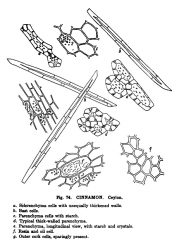
Ceylon Cinnamon (powdered bark) (Cinnamomum verum) / (Cinnamomum zeylanicum Nees)
Source: Schneider, A. (1921) The Microanalysis of Powdered Vegetable Drugs, 2nd ed.[13]
|
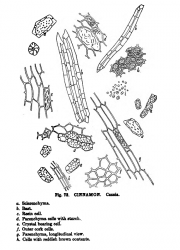
Compare to Cinnamon aromaticum.
Source: Schneider, A. (1921) The Microanalysis of Powdered Vegetable Drugs, 2nd ed.[14]
|

Compare to Cinnamon loureiroi.
Source: Schneider, A. (1921) The Microanalysis of Powdered Vegetable Drugs, 2nd ed.[15]
|
|
High Performance Thin Layer Chromatographic Identification
Supplementary Information
Sources
- ↑ MOBOT, Tropicos.org http://www.tropicos.org/Image/100003409
- ↑ Botanical Voucher Specimen Library, Alkemists Laboratories http://www.alkemist.com
- ↑ Royal Botanic Gardens, Kew. http://specimens.kew.org/herbarium/K000350931
- ↑ Schneider, A. (1921) The Microanalysis of Powdered Vegetable Drugs, 2nd ed.
- ↑ Culbreth, D. (1917) A Manual of Materia Media and Pharmacology, 6th ed.
- ↑ Culbreth, D. (1917) A Manual of Materia Media and Pharmacology, 6th ed.
- ↑ PlantaPhile http://plantaphile.com/
- ↑ PlantaPhile http://plantaphile.com/
- ↑ Schneider, A. (1921) The Microanalysis of Powdered Vegetable Drugs, 2nd ed.
- ↑ Culbreth, D. (1917) A Manual of Materia Media and Pharmacology, 6th ed.
- ↑ Elan M. Sudberg, Alkemist Laboratories http://www.alkemist.com
- ↑ Elan M. Sudberg, Alkemist Laboratories http://www.alkemist.com
- ↑ Schneider, A. (1921) The Microanalysis of Powdered Vegetable Drugs, 2nd ed.
- ↑ Schneider, A. (1921) The Microanalysis of Powdered Vegetable Drugs, 2nd ed.
- ↑ Schneider, A. (1921) The Microanalysis of Powdered Vegetable Drugs, 2nd ed.